Is Claude Code nerfed? What 48 days of my own usage logs actually show
In 48 days, Claude Code went through $935 worth of tokens - on a flat monthly subscription. Twice in September I hit my session limit right in the middle of work, and everywhere I looked people had a theory: limits got cut, the new model thinks less, Anthropic quietly made it dumber. Nobody showed actual numbers. Then I realised I have them.
Where the data lives
Claude Code keeps a log of everything it does, on your own computer: a hidden folder in your
home directory, ~/.claude/projects, one file per session. Every reply from the model
comes with a usage block - fresh input, cache writes, cache reads, output, even the thinking
tokens - plus which model it was and the effort level. So I built a small tool that reads all of
it. It is one Python file with no packages, and it only reads files: nothing leaves your machine.
python3 skill/usage-tracker/usage.py --redact
--redact swaps project names for placeholders, so you can share a screenshot. It
prints a summary and writes an HTML dashboard: cost per day, the days you hit a limit in red, cost
per model and per project.
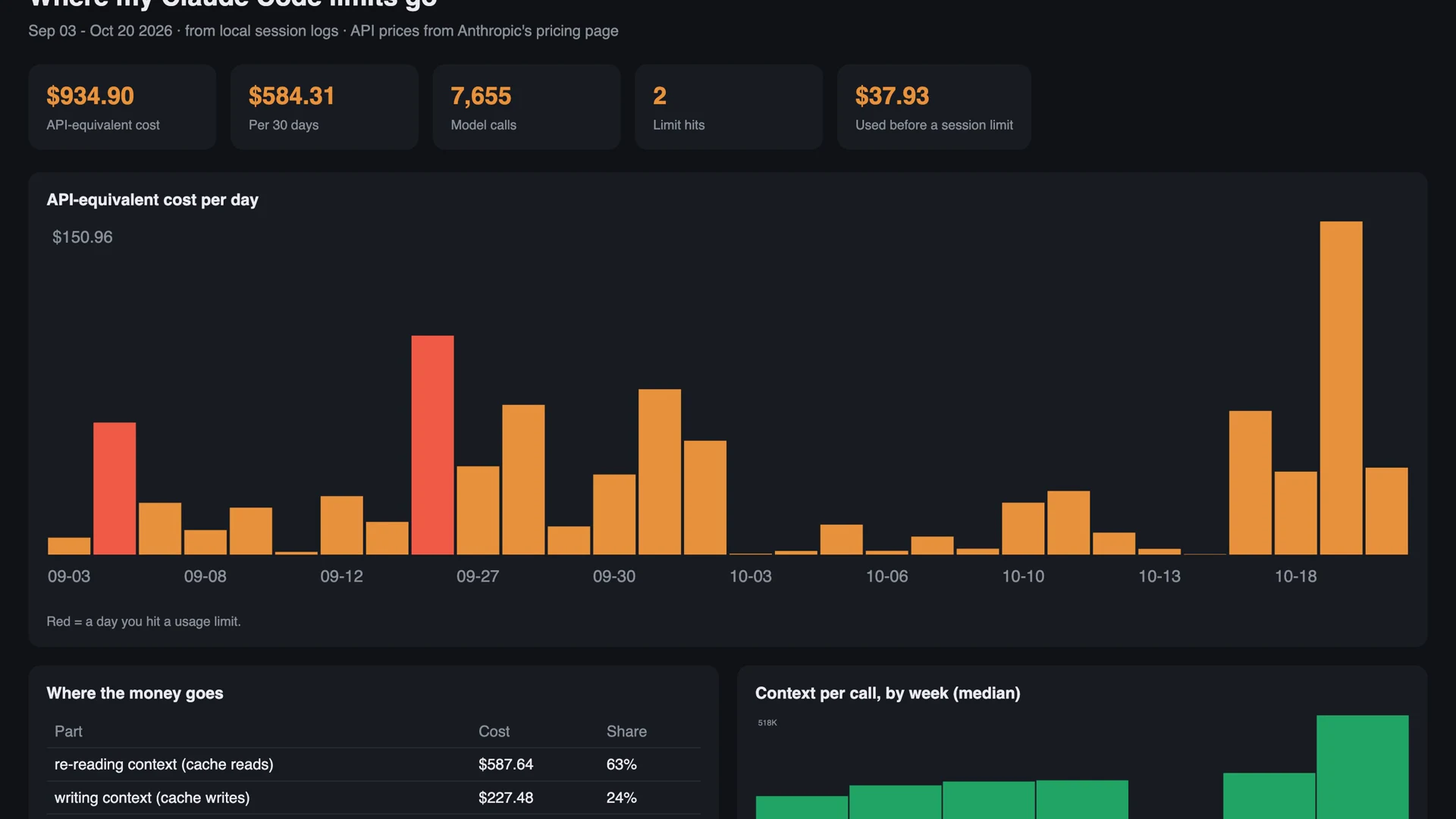
These dollars are not my bill. I pay a flat monthly price. They are what the same tokens would cost on the API at Anthropic's published prices - the best ruler there is, because Anthropic does not publish exactly how subscription limits are counted.
Where the money goes
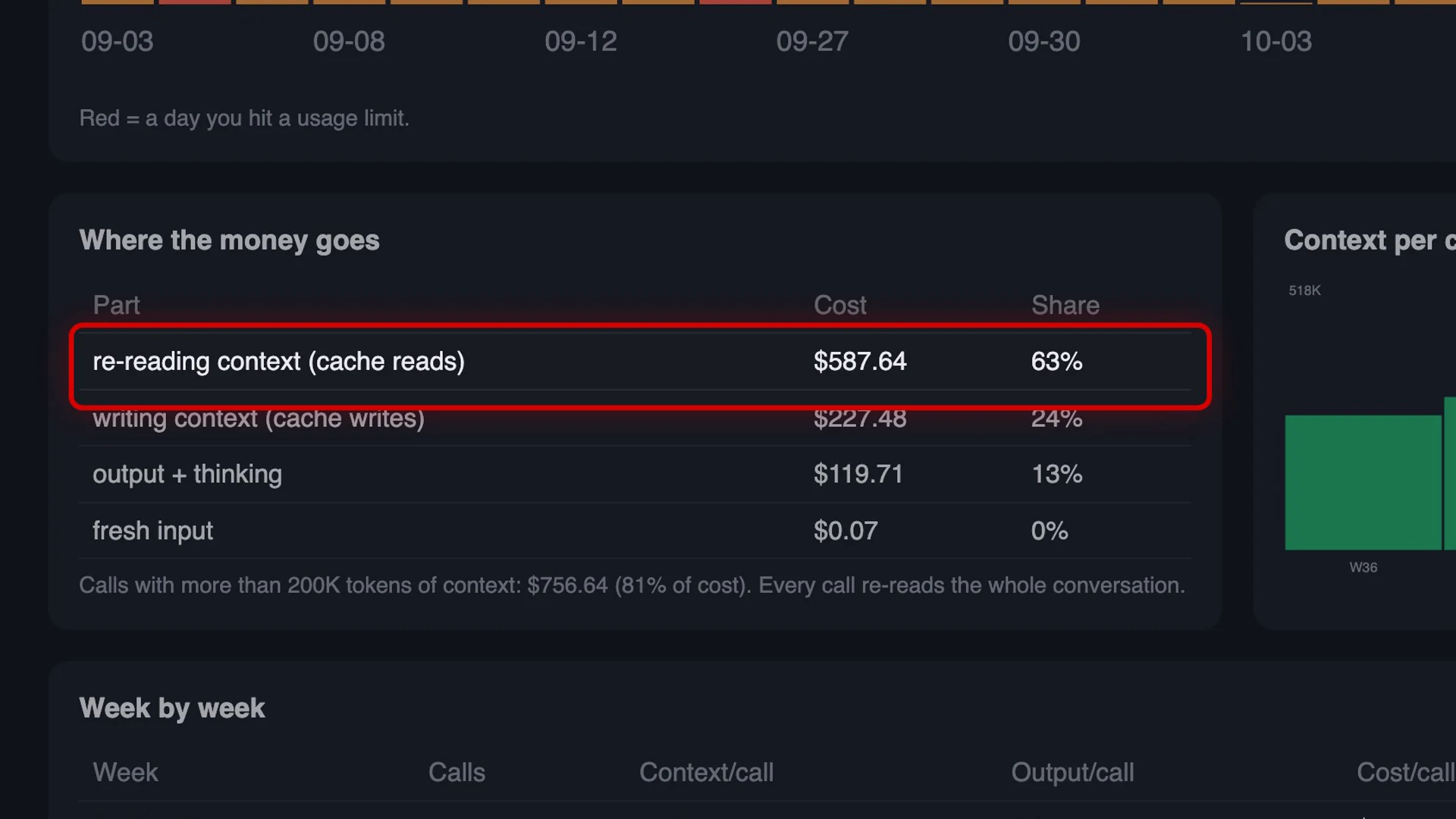
This was the surprise. Only 13% goes to what Claude actually writes. 63% is Claude re-reading the conversation: every time it takes one step, it reads the whole session again from the cache.
So, is it nerfed?
Week by week, the output per call is basically flat: around 400 to 500 tokens, every week. Claude is not writing less. What changed is the context. Two weeks before the video, my typical call carried 127,000 tokens; that week, 518,000. Four times more.
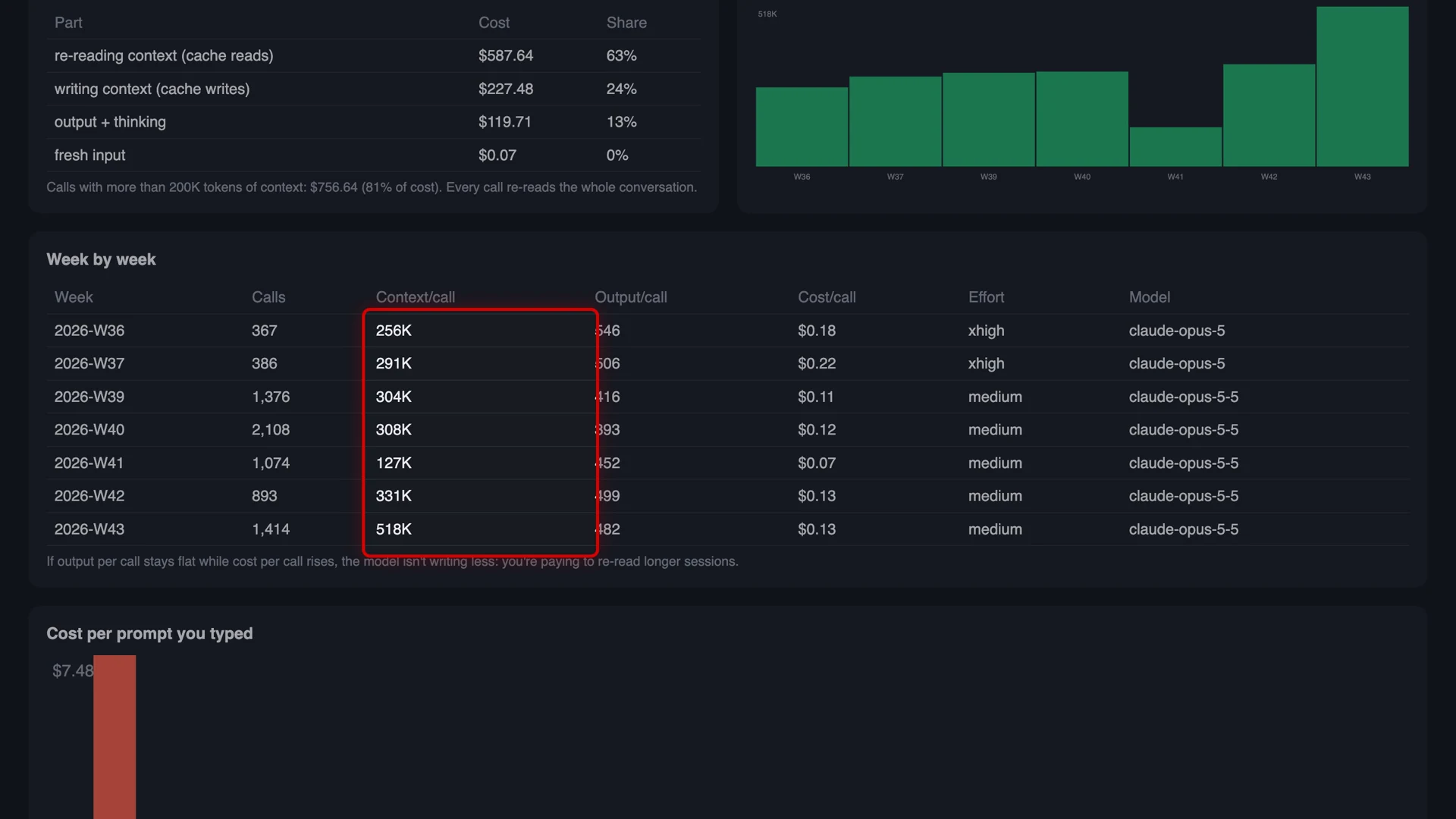
The logs show one more thing: Opus 5 ran on extra-high effort, Opus 5.5 runs on medium. Per call, the newer model is actually cheaper.
The limit hits
The logs record every time you hit a limit and when it resets, so the tool adds up what you used in that five-hour window. My first hit came after $41 of API-equivalent usage, the second after $35. But the night before the video I had a $65 block and no limit at all. I cannot explain that from the logs - maybe my phone or the website counted too in September, since they share the same limit but are not in these files. So I will not pretend I know the exact limit.
What actually helps
- Start a fresh session for every new task, instead of one giant session all day.
- Use
/compactwhen a session gets long - there is less to re-read on every step. - Keep your CLAUDE.md short. It is re-read on every single call.
That is where my limits really went. From my own data, Claude Code is not nerfed: the model writes about the same as before, and my sessions got four times longer.
Or just ask Claude Code
The tracker is also a Claude Code skill. Copy it into ~/.claude/skills/ and ask
"am I being nerfed?" or "where did my usage go this week?" - it runs the tool,
reads the numbers, and answers with them.
Claude Code usage tracker - the script and the skill
Your own numbers in about ten seconds, from logs that are already on your computer.
- usage.py - one Python file, standard library only: terminal summary plus an HTML dashboard.
- The Claude Code skill - ask "am I being nerfed?" and get an answer with your numbers.
- Every view from this page - cost per day, model and project, where the money goes, limit hits, biggest 5-hour blocks, week by week.
- --redact to hide project names before you share a screenshot.
Patreon members ($5/month) get it with all my other tools, or buy just this one for $9.
Honest limitations
- The dollar figures are API-equivalent, not your subscription bill, and Anthropic does not publish exactly how limits are counted.
- It only sees this computer's logs. Usage on claude.ai or your phone shares the limit but is not included.
- Claude Code deletes logs older than about 30 days by default - set
cleanupPeriodDaysin settings.json to keep more. - It is one person's data. Run it on yours before drawing conclusions about anyone's limits.
Watch the video
The dashboard, where the money goes, the week-by-week check, and asking Claude Code directly.
FAQ
How do I check my Claude Code usage?
Claude Code logs every model call in ~/.claude/projects on your computer. The tracker reads those logs and shows cost per day, per model and per project, where the tokens go, and every time you hit a limit.
Is Claude Code nerfed?
Not in my data: over 48 days, output per call stayed flat at about 400-500 tokens a week. What grew was my context per call, from 127K to 518K tokens - longer sessions, not a weaker model.
Why do I hit Claude Code limits so fast?
In my logs, 63% of the cost was Claude re-reading the conversation, and 81% came from calls with more than 200K tokens of context. Fresh sessions per task, /compact and a short CLAUDE.md help most.
Does the tracker send my data anywhere?
No. It is one Python file that only reads the local log files and writes a local HTML report.
Related
Want to see where your team's AI spend goes?
Measuring usage from the data you already have, instead of guessing, is most of what I do at KorFlux - for AI tools, infrastructure and monitoring alike.